Controlled vocabularies play an important role in the metadata indexing and retrieval process. Their use is required, or at least recommended, by metadata schemas (e.g., DCAT-AP, CCMM). The definition of controlled vocabulary and other terms are explained in the Basic Concepts section.
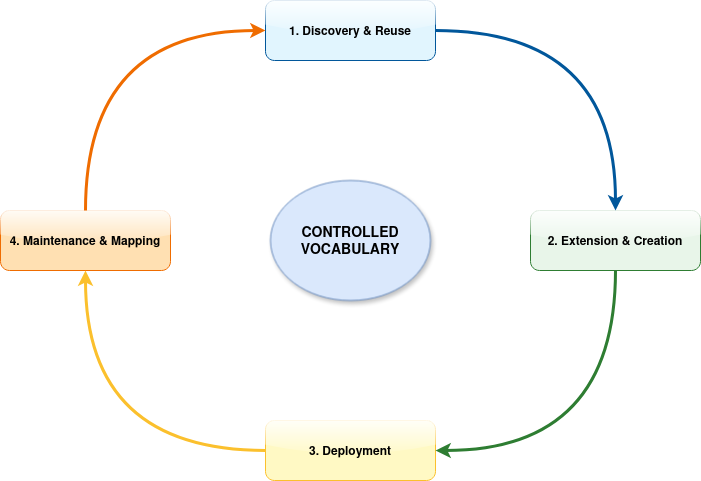
Controlled vocabularies, like other IT artifacts, have their own lifecycle (Figure 1).
The final deliverable of the Task Force is the document “Controlled Vocabulary Management Guidelines for NRP/NDI”. This document is intended to serve as a recommended framework for systematic work with controlled vocabularies within the NRP/NDI environment. It is not a binding standard, but rather methodological support that enables a unified approach across domain repositories. The document will cover the entire process of working with controlled vocabularies, from their selection or creation by domain repositories to their registration in the NKR.
The inputs to the final document consist of recommendations covering individual phases of the controlled vocabulary lifecycle. Only selected parts are incorporated into the final document, complete with links to the original documents, along with additional relevant topics (Figure 2). Efforts are made to use consistent terminology and abbreviations across all documents; this will also be explained in the final document and on the website under Basic Concepts and Abbreviations and Acronyms. Literature references will be listed on the website by topic. Individual sections of the website are continuously updated. The current status of the documents is presented in the following table:
| Document Title | Status |
| Controlled Vocabulary Update Request (otevřeno komentářům pro členy PS Metadata) | Open for comments by WG Metadata |
| Building Controlled Vocabularies: From Principles to SKOS Implementation | In progress |
| Versioning Controlled Vocabularies: Approaches and Recommendations (otevřeno komentářům pro členy PS Metadata) | Open for comments by WG Metadata |
| Semantic Artefact Mapping: Methodology and Recommended Practices (otevřeno komentářům pro členy PS Metadata) | Open for comments by WG Metadata |
| Controlled Vocabulary Management Guidelines for NRP/NDI | In progress |
Explanation of the purpose and content of individual documents:
- Building Controlled Vocabularies: From Principles to SKOS Implementation: The document aims to establish a recommended procedure for creating new controlled vocabularies when no suitable existing vocabulary is available for a domain repository within the NRP/NDI environment. Combining theoretical foundations with practical steps for vocabulary development, the document focuses on leveraging the SKOS data model and its benefits for semantic interoperability. Furthermore, it describes the specific workflow for developing vocabularies in this format and specifies a minimum set of descriptive elements according to controlled vocabulary type.
- Controlled Vocabulary Update Request: The document aims to establish a recommended methodology for receiving and processing change requests for controlled vocabularies within NRP/NDI environment. Based on an analysis of international practice and normative standards (e.g., ANSI/NISO, ČSN, OBO Foundry), the document defines procedures for three basic types of requests: adding a new element, deprecating an element (primarily by marking it as “obsolete” rather than deleting it), and modifying an existing element. It also specifies the minimum requirements for requests, quality control principles, and community governance aspects.
- Versioning Controlled Vocabularies: Approaches and Recommendations: The document aims to establish a recommended procedure for versioning SKOS controlled vocabularies within NRP/NDI environment. The document compares existing versioning approaches and recommends a weak versioning model for the NDI environment, using persistent URIs and metadata-tagged versions. Furthermore, it defines properties for describing changes at both the vocabulary and element levels and specifies rules for namespace management, storage, and version control within the National Catalogue of Repositories (NKR).
- Semantic Artefact Mapping: Methodology and Recommended Practices: The document aims to define a recommended methodology for mapping semantic artefacts (primarily SKOS controlled vocabularies) within the National Data Infrastructure environment. The methodology describes a seven-phase mapping life cycle, ranging from preparation, candidate discovery, and evaluation to formalisation, publication, and version management. The document specifies recommended processes, tool-independent approaches, and standardized formats (e.g., SSSOM, JSKOS) to ensure semantic interoperability, FAIR principles, and the long-term sustainability of mappings. Within the document, NTK provides an overview and comparison of suitable tools for individual process phases and defines infrastructure requirements for storing and providing access to mappings.
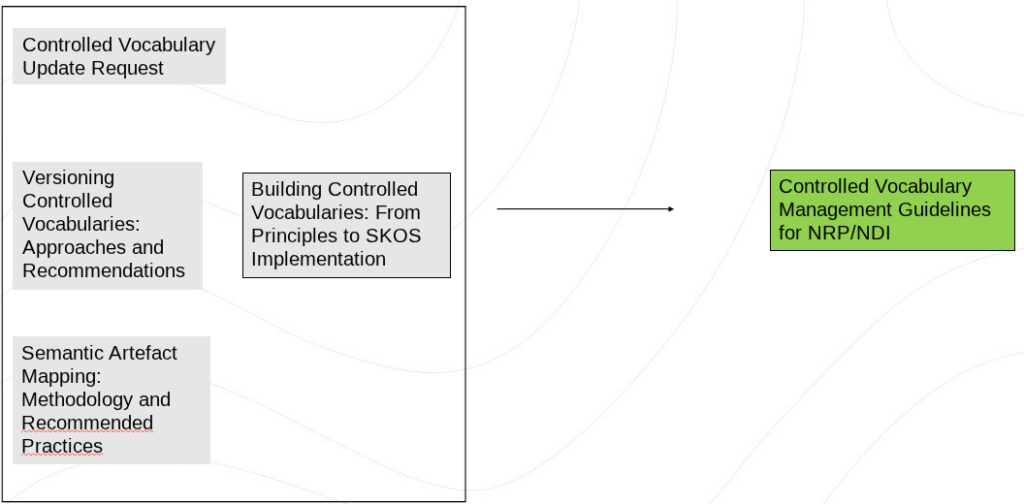
Current working structure (will be updated accordingly) and topics of the final document “Controlled Vocabulary Management Guidelines for NRP/NDI” according to the individual phases of the lifecycle:
- Finding an external controlled vocabulary (Discovery & Reuse phase) will be included in Chapter 2 as part of the workflow for working with controlled vocabularies in the NRP.
- The deployment phase of a controlled vocabulary depends on the specific domain repository and its software implementation. In this document, deployment is addressed in terms of registration in the NKR in Chapter 2.
- An explanation of the roles of people involved with controlled vocabularies in the NRP will be included in Chapter 2.
- The recommended procedure for creating (Creation) a new controlled vocabulary will be presented in Chapter 3.
- The extension (Extension) of an existing controlled vocabulary will be part of Chapter 4, “Updating a Controlled Vocabulary,” including coverage of the topic “External request to update a controlled vocabulary” in Chapter 4.1.
- The mapping of controlled vocabularies will be explained in the context of semantic artifacts mapping in Chapter 5.