Concordance
A concordance is an explicit relationship between elements of semantic artefacts (in line with tools such as Cocoda).
Controlled Vocabulary
“A controlled vocabulary is an explicitly defined [structure] of terms managed by a registering authority” (ANSI/NISO, 2010). Such a list should be uniquely identifiable and specified using web standards (Åkerström et al., 2024). Controlled vocabularies can take various forms; within the scope of this work, we understand a controlled vocabulary primarily as a mode of using a semantic artefact.
Typical instances of controlled vocabularies include term lists, taxonomies, and thesauri (ANSI/NISO, 2010), which can be represented using the SKOS data model (Miles & Bechhofer, 2009). However, the role of a controlled vocabulary can also be played by a part of a formal ontology, just as a formal ontology may itself utilize controlled vocabularies (Harpring, 2010).
Crosswalk
A crosswalk defines relationships between elements of semantic artefacts to enable interoperability and effective data exchange through data transformation and conversion. (Åkerström, W. N. et al, 2024)
Dereferenceability
Dereferenceability means that the URI can be successfully dereferenced via HTTP, returning , for example, both RDF metadata and HTML representation.
Knowledge representation language
A knowledge representation language is a formal language that enables the capture of knowledge in a machine-understandable semantic form.
Semantic Artefact Catalogue
“A Semantic Artefacts Catalogue is a dedicated web-based system that fosters the availability, discoverability, long-term preservation and maintenance of semantic artefacts.” (Åkerström, W. N. et al, 2024)
Mapping
Mapping is an explicit relationship between elements of semantic artefacts. (Åkerström, W. N. et al, 2024)
Mapping (Matching)
A mapping process is a manual or (semi-)automated function that, given input semantic artefacts, yields a set of mappings (an alignment) as output (Euzenat & Shvaiko, 2013).
Ontology
The term ontology can refer to many different semantic artefacts. Within the context of the Task Force, an ontology is understood as a formal ontology, defined as an explicit specification of a shared conceptualization (Borst, 1997). Ontologies serve to represent knowledge in the field of artificial intelligence.
The established web standards for ontology representation are:
- OWL 2 Web Ontology Language (W3C, 2012) as an advanced ontology modeling language.
- RDF Schema 1.1 (Brickley & Guha, 2014) as a language for lightweight ontology modeling.
The web standard for data representation itself is the Resource Description Framework (RDF) 1.2 serving as the foundational data model (Seaborne et al., 2026).
Provenance
“Provenance is information about entities, activities, and people involved in producing a piece of data or thing, which can be used to form assessments about its quality, reliability or trustworthiness.” (Moreau & Missier, 2013)
Semantic Artefact
A semantic artefact is a machine-readable formalization of a shared conceptualization. These artefacts encompass a wide range of types with varying degrees of formalization and expressiveness from less formal term lists, thesauri, and taxonomies to metadata schemas and highly formal ontologies (Åkerström et al., 2024), see Figure 1.
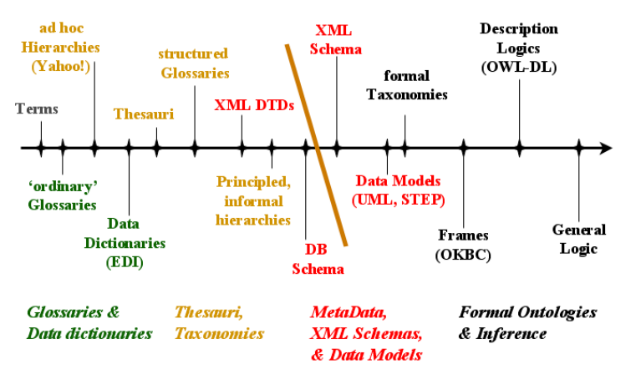
Uschold and Gruninger , 2004
The connection between semantic artefacts and ontologies is intentional. The term semantic artefact was introduced in the EOSC recommendation (Le Franc et al., 2020) specifically to replace the often overloaded term ontology in broader contexts. Within this document, the term element is used to refer to the atomic constituents of semantic artefacts.
Semantic artefacts are represented using W3C standards (such as RDF, RDFS, OWL, and SKOS) alongside various serialization formats (such as Turtle, JSON-LD, RDF/XML, and XML Schema).
Technical Artefact
By technical artefact we mean a concrete physical realization (serialization) of a semantic artefact in a specified data format and encoding. It represents the encoding of an abstract semantic model (e.g., an RDF graph or an OWL ontology) into a text or binary sequence intended for storage or network transmission. A single semantic artefact can correspond to multiple technical artefacts in different syntaxes (e.g., Turtle, JSON-LD, RDF/XML).
References
Åkerström, W. N., Baumann, K., Corcho, O., David, R., Le Franc, Y., Madon, B., … & Widmann, H. (2024). Developing and implementing the semantic interoperability recommendations of the EOSC Interoperability Framework. Zenodo. https://zenodo.org/records/10843882
ANSI/NISO. (2010). Guidelines for the Construction, Format, and Management of Monolingual Controlled Vocabularies (ANSI/NISO Z39.19-2005 (R2010)). NISO.
Borst, W. N. (1997). Construction of engineering ontologies for knowledge sharing and reuse [Doktorská práce, University of Twente].
Cyganiak, R., Wood, D., & Lanthaler, M. (Eds.). (2014, February 25). RDF 1.1 Concepts and Abstract Syntax. W3C Recommendation. https://www.w3.org/TR/rdf11-concepts/
Euzenat, J., & Shvaiko, P. (2013). Ontology matching (2nd ed.). Springer. https://doi.org/10.1007/978-3-642-38721-0
Harpring, P. (2013). Introduction to controlled vocabularies: Terminology for art, architecture, and other cultural works. Getty Publications.
Le Franc, Y., Parland-von Essen, J., Bonino, L., Lehväslaiho, H., Coen, G., & Staiger, C. (2020). D2.2 FAIR Semantics: First recommendations. Zenodo. https://zenodo.org/records/5361930
Miles, A., & Bechhofer, S. (Eds.). (2009, August 18). SKOS Simple Knowledge Organization System Reference. W3C Recommendation. https://www.w3.org/TR/skos-reference/
Moreau, L., & Missier, P. (Eds.). (2013, April 30). PROV-DM: The PROV data model. W3C Recommendation. https://www.w3.org/TR/prov-dm/
Motik, B., Patel-Schneider, P. F., & Parsia, B. (Eds.). (2012, December 11). OWL 2 Web Ontology Language: Structural Specification and Functional-Style Syntax (2nd ed.). W3C Recommendation. https://www.w3.org/TR/owl2-syntax/
Seaborne, A., Kellogg, G., Hartig, O., & Champin, P.-A. (Eds.). (2026, April 7). RDF 1.2 Concepts and Abstract Data Model. W3C Candidate Recommendation. https://www.w3.org/TR/rdf12-concepts/
Uschold, M., & Gruninger, M. (2004). Ontologies and semantics for seamless connectivity. ACM SIGMOD Record, 33(4), 58–64. https://doi.org/10.1145/1041410.1041420